
Oil–water emulsions are a costly, persistent problem across the refining, storage, and waste management industries. Traditional treatment methods rely on chemical demulsifiers, long settling times, or heavy centrifuges — all of which add cost, waste, and complexity.
The process uses precisely controlled energy and gentle conditioning to destabilise emulsions without harsh chemicals or complex reagents.
A small dose of our proprietary additive is introduced to the emulsion to pre-condition the mixture for separation.
The sample is gently heated to the optimum operating range (typically 50–70 °C) to improve flow and energy transfer.
High-frequency acoustic waves create microscopic pressure zones within the fluid. These disrupt the molecular bonds that stabilise the emulsion.
The oil rapidly coalesces and rises, forming a clean top layer. Water clarifies beneath, with any fine solids settling to the bottom.
Laboratory and pilot trials have demonstrated rapid, visible phase separation immediately after ultrasonic treatment:
Clear oil–water interface formed within 5–20 minutes
Complete three-layer structure: oil (top), water (middle), solids (bottom)
No chemical demulsifiers or centrifuges required
High oil recovery and minimal secondary waste
Effective across a wide range of oil viscosities and contamination levels
After a short settling period, the treated sample forms distinct clean layers, confirming
complete and stable phase separation using acoustic energy alone.
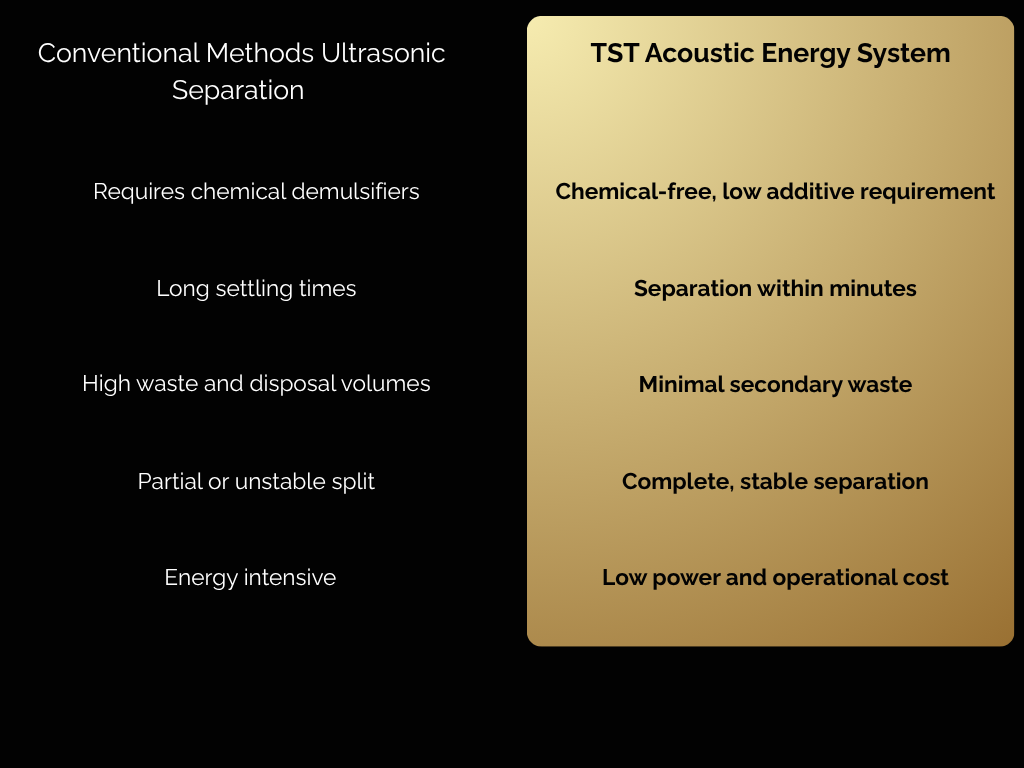
TST’s acoustic separation technology replaces costly, chemical-heavy treatment with a clean, circular process.
Recovered oil is returned to use, clean water is safely discharged or reused, and minimal solids are sent to disposal. This approach cuts operational costs, eliminates confined-space risk, and aligns with environmental targets for waste reduction and carbon impact.